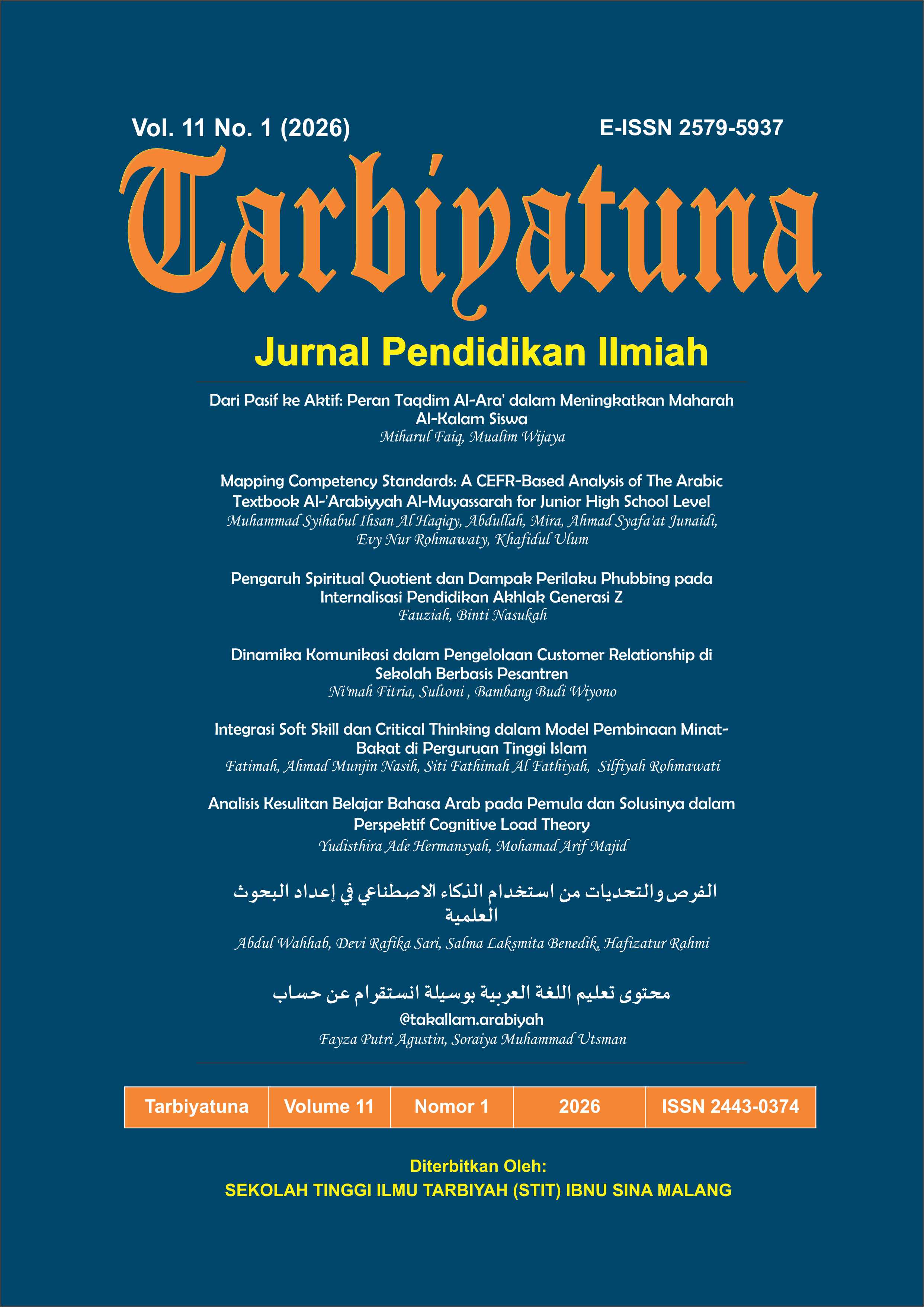
Integrasi Soft Skill dan Critical Thinking dalam Model Pembinaan Minat-Bakat di Perguruan Tinggi Islam
Abstract
The development of student achievement in university still tends to focus on academic achievement, while the strengthening of soft skills and critical thinking abilities has not been optimally integrated into student development policies. In fact, these two competencies play an important role in increasing student competitiveness. Based on these conditions, this study aims to analyze the contribution of interest and talent development programs in strengthening students' soft skills and critical thinking as a strategy for improving competitive achievement. This study used a qualitative descriptive approach and was conducted at the Badrus Sholeh Islamic Institute in Kediri. The research subjects were high-achieving students in the Arabic Language Education Study Program in semesters 1–7 who participated in the talent development program. Data were collected through in-depth interviews, structured observations, and documentation of student achievements, then analyzed using data condensation, data presentation, and conclusion drawing techniques.. The results of the study show that structured and sustainable talent development programs can strengthen students' soft skills, particularly public communication, teamwork, self-confidence, discipline, and leadership. In addition, these programs encourage students to improve their critical thinking skills through activities such as issue analysis, argumentation, text evaluation, and performance reflection in competitive activities. The integration of soft skills and critical thinking through talent interest programs has been proven to contribute to students' success in achieving seven competitive achievements throughout 2024-2025 at the district, provincial, and national levels. This study recommends strengthening talent interest development policies as an institutional strategy to improve student competitiveness.
References
Adhitya Pratama, D. P., Subroto, W. T., & Sakti, N. C. (2025). Soft skills and Entrepreneurial Spirit: Integration of Skills through Continuing Education for Indonesian Students in the Era of Globalization 21st Century. International Journal of Research and Scientific Innovation, XI(XII), 733–744. https://doi.org/10.51244/IJRSI.2024.11120065
Bansa, Y. A., Syafa’at, A., Soma, R., Abrar, M., & Rosita, R. (2025). Pengembangan Soft skill Public Speaking Bagi Mahasiswa. Monsu’ani Tano Jurnal Pengabdian Masyarakat, 8(2), 173–181.
Beebe, J. (2014). Rapid Qualitative Inquiry: A Field Guide to Team-Based Assessment. Bloomsbury Publishing PLC.
Chen, X., Zhai, X., Zhu, Y., & Li, Y. (2022). Exploring debaters and audiences’ depth of critical thinking and its relationship with their participation in debate activities. Thinking Skills and Creativity, 44, 101035.
Creswell, J. W. (2014). Research Design: Qualitative, Quantitative, and Mixed Methods Approaches. SAGE.
Dess, G. G., & Picken, J. C. (2000). Changing roles: Leadership in the 21st century. Organizational dynamics, 28(3), 18–34.
Dwyer, C. P., Hogan, M. J., & Stewart, I. (2014). An integrated critical thinking framework for the 21st century. Thinking skills and Creativity, 12, 43–52.
Febrina, E., & Mukhidin, M. (2019). Metakognitif sebagai keterampilan berfikir tingkat tinggi pada pembelajaran abad 21. Edusentris, 6(1), 25–32.
Feraco, T., Resnati, D., Fregonese, D., Spoto, A., & Meneghetti, C. (2023). An integrated model of school students’ academic achievement and life satisfaction. Linking soft skills, extracurricular activities, self-regulated learning, motivation, and emotions: T. Feraco et al. European Journal of Psychology of Education, 38(1), 109–130.
Fitriani, D., & Setyono, H. (2022). Model Pengembangan Minat Dan Bakat Mahasiswa. JURNAL HURRIAH: Jurnal Evaluasi Pendidikan Dan Penelitian, 3(1), 1–10. https://doi.org/10.56806/jh.v3i1.59
Franco, A., Marques Vieira, R., & Tenreiro-Vieira, C. (2018). Educating for critical thinking in university: The criticality of critical thinking in education and everyday life. Essachess. Journal for Communication Studies, 11(2), 22.
Hanur, B. S., Fauziah, G. E., Fatimah, F., & Sari, R. (2025). Skill Reinforcement Management of Inclusive Education towards Shadow Teachers in Islamic Institutions. Al Hikmah Indonesian Journal of Early Childhood Islamic Education, 9(1), 33–49.
Kadarisman, A., Jaya, F., & Sucipto, Y. (2024). Transformasi Pendidikan Ekonomi Melalui Integrasi Soft skills Abad Ke-21. Jurnal Manajemen Pendidikan Dan Ilmu Sosial, 5(5).
Kennedy, R. (2007). In-class debates: Fertile ground for active learning and the cultivation of critical thinking and oral communication skills. International Journal of Teaching & Learning in Higher Education, 19(2).
Komara, E. (2018). Penguatan Pendidikan Karakter dan Pembelajaran Abad 21. SIPATAHOENAN, 4(1). https://doi.org/10.2121/sip.v4i1.991
Manurung, A. S., Fahrurrozi, E. U., & Gumelar, G. (2023). Implementasi berpikir kritis dalam upaya mengembangkan kemampuan berpikir kreatif mahasiswa. Jurnal Papeda, 5(2).
Matteson, M. L., Anderson, L., & Boyden, C. (2016). “ Soft skills”: A phrase in search of meaning. portal: Libraries and the Academy, 16(1), 71–88.
Moleong, L. J., & Surjaman, T. (1989). Metodologi penelitian kualitatif. Remadja Karya. https://books.google.co.id/books?id=YXsknQEACAAJ
Moleong, Lexy J.,. (2017). Metodologi Penelitian Kualitatif. PT Remaja Rosdakarya.
Muhmin, A. H. (2018). Pentingnya pengembangan soft skills mahasiswa di perguruan tinggi. Forum Ilmiah, 15(2), 330–338.
Mulyana, H. A., WC, C., & Ht, C. H. C. (2025). Critical thinking: Menuju Berargumen Logis dan Terstruktur. Goresan Pena.
Nafi’ah, S. (2022). Pembinaan Guru Model dalam Matematika untuk Mengembangkan Minat dan Bakat Siswa dengan Teknik Self Management Semester Ganjil Tahun Pelajaran 2019/2020. Jurnal Pembelajaran dan Ilmu Pendidikan, 2(1), 47–56.
Nugraha, M. T. (2026). Integrasi Keterampilan Abad 21 di Perguruan Tinggi. Muhamad Tisna Nugraha.
Obilor, E. I. (2019). Soft skills and students’ academic achievement. The International Journal of Community and Social Development, 7(2), 27–37.
Oktavianti, F. (2019). Manajemen peserta didik dalam pengembangan minat dan bakat melalui kegiatan ekstrakurikuler. Joyful Learning Journal, 8(4), 184–192.
Paxton, D., & Van Stralen, S. (2015). Developing collaborative and innovative leadership: Practices for fostering a new mindset. Journal of leadership education, 14(4), 11–25.
Pithers, R. T., & Soden, R. (2000). Critical thinking in education: A review. Educational research, 42(3), 237–249.
Poláková, M., Suleimanová, J. H., Madzík, P., Copuš, L., Molnárová, I., & Polednová, J. (2023). Soft skills and their importance in the labour market under the conditions of Industry 5.0. Heliyon, 9(8).
Rahmadani, P. N., Arthur, R., & Maulana, A. (2023). Integrasi konsep literasi vokasional untuk mengembangkan berpikir kritis pada siswa SMK: Sebuah kajian pustaka. Jurnal Pendidikan West Science, 1(12), 817–826.
Rusliana, I., Pribadi, P., & Supriatna, N. (2024). Pengembangan Kepemimpinan Pada Mahasiswa Generasi Z Melalui Program Pelatihan Soft skills. KhidmatMu, 1(1), 18–26.
Schafersman, S. D. (1991). An introduction to critical thinking.
Setiani, F., & Rasto, R. (2016). Mengembangkan soft skill siswa melalui proses pembelajaran. Jurnal pendidikan manajemen perkantoran, 1(1), 160–166.
Shahidi Hamedani, S., Aslam, S., Mundher Oraibi, B. A., Wah, Y. B., & Shahidi Hamedani, S. (2024). Transitioning towards tomorrow’s workforce: Education 5.0 in the landscape of society 5.0: A systematic literature review. Education Sciences, 14(10), 1041.
Sugiyono. (2019). Metode Penelitian Kualitatif, Kuantitatif, dan R&D. Alfabeta.
Tushar, H., & Sooraksa, N. (2023). Global employability skills in the 21st century workplace: A semi-systematic literature review. Heliyon, 9(11).
Yulian, R. (2021). The flipped classroom: Improving critical thinking for critical reading of EFL learners in higher education. Studies in English language and education, 8(2), 508–522
Copyright (c) 2026 Fatimah Fatimah, Ahmad Munjin Nasih, Siti Fathimah Al Fathiyah, Silfiyah Rohmawati

This work is licensed under a Creative Commons Attribution-ShareAlike 4.0 International License.