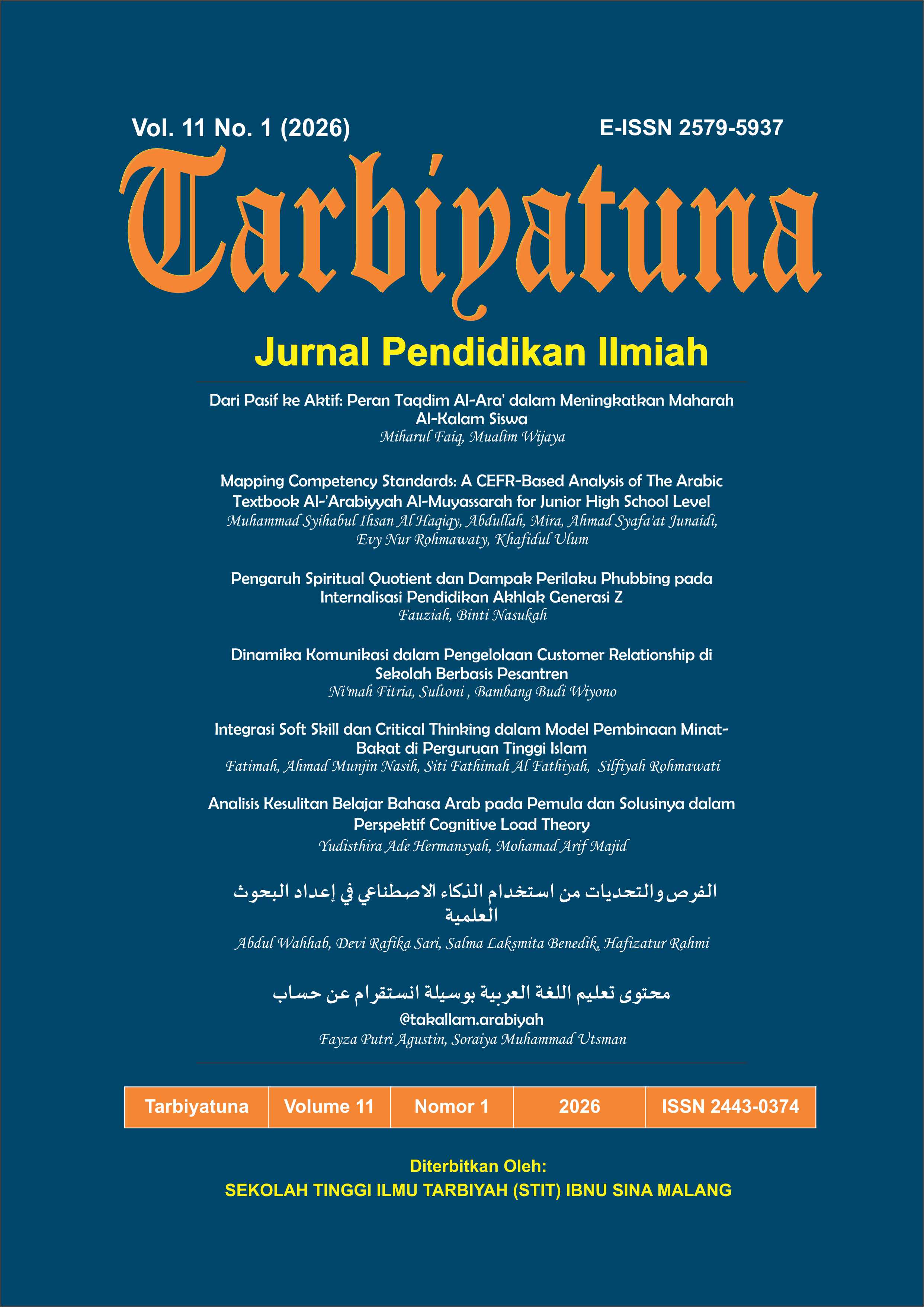
Dari Pasif Ke Aktif: Peran Taqdīm Al-Ārā’ dalam Meningkatkan Mahārah al-Kalām Siswa
الملخص
This study is based on the phenomenon that most students still experience difficulties in expressing their opinions orally due to low self-confidence, limited vocabulary, and fear of making mistakes while speaking. This research aims to describe the impact of the Taqdimul Ara’ activity in improving students’ maharah kalam (speaking skills) at LPBA Nurul Jadid. This study employed a descriptive qualitative approach. Data were collected through observation, interviews, and documentation during the implementation of the Taqdimul Ara’ activity. The data were analyzed through data reduction, data display, and conclusion drawing. The findings reveal that the Taqdimul Ara’ activity has a positive impact on students’ speaking skills, including increasing their confidence and courage to speak, improving fluency, enriching vocabulary, and training students to organize their arguments in a coherent and systematic way. In addition, this activity also strengthens the communicative culture within the LPBA Nurul Jadid environment. This study confirms that Taqdimul Ara’ is a viable alternative instructional strategy for developing foreign language speaking skills, particularly in Islamic boarding school-based educational institutions.
المراجع
Abdulhafid, S., Aboubakr, K., Mustapha, N. F., Hassan, A. R., & Ismail, M. Z. (2024). Improvement of Arabic speaking skills among non-Arabic students through role-play activities. International Journal of Academic Research in Progressive Education and Development, 13(1), 2299–2313.https://doi.org/10.6007/IJARPED/v13-i1/20760
Abdullah, F., & Fauziah, T. H. (2026, January). The use of role-play and guided discussion techniques as speaking strategies in Arabic language learning at madrasah aliyah. In Gunung Djati Conference Series (Vol. 62, pp. 87–95).
Albana, R. K., Arifin, S., Ridlo, U., Wahab, M. A., & Susiawati, W. (2023). Efektivitas penggunaan metode role play untuk meningkatkan keterampilan berbicara bahasa Arab. Kordinat: Jurnal Komunikasi antar Perguruan Tinggi Agama Islam, 22(2), 269–280.https://doi.org/10.15408/kordinat.v22i2.44847
Alhamzah, K., & Amrulloh, M. A. (2025). Pembelajaran bahasa Arab dengan pendekatan komunikatif terhadap kemampuan mahārah al-kalām di Madrasah Tsanawiyah. Lisan An Nathiq: Jurnal Bahasa dan Pendidikan Bahasa Arab, 7(2), 385–402.
Amrulloh, S., Mubaidilah, A., & Nur, K. (2025). Integrasi pembelajaran bahasa Arab pada mahārah al-kalām melalui kitab Al-‘Arabiyyah Baina Yadaik pada santri program tahfidz: Analisis kualitatif di Ponpes Bustanul ‘Ulum Lampung Tengah. Ihtimam: Jurnal Pendidikan Bahasa Arab, 8(02), 16–25.https://doi.org/10.36668/jih.v8i02.1503
Bahruddin, U., Ramadhan, M. F., & Bahruddin, W. (2021). Improvement of speaking skills through the use of Arabic as an introduction language. Turkish Journal of Computer and Mathematics Education, 12(8), 2760–2768. Retrieved from https://turcomat.org/index.php/turkbilmat/article/view/4005
Creswell, J. W. (2014). Research design: Qualitative, quantitative, and mixed methods approaches (4th ed.). SAGE Publications.
Fadhilah, M. I. N., & Jauhari, Q. A. (2025). Implementasi pembelajaran bahasa Arab berbasis praktik langsung pendekatan communicative language teaching untuk meningkatkan kepercayaan diri siswa MA Tarbiyatul Banin Banat Tuban. Maharaat Lughawiyyat: Jurnal Pendidikan Bahasa Arab, 4(1), 15–29. https://doi.org/10.18860/jpba.v4i1.14824
Hapid, N. (2023). Penerapan metode langsung (thoriqoh mubasyarah) dalam meningkatkan keterampilan berbicara bahasa Arab, 265–270.https://doi.org/10.61116/jhpp.v1i4.220
Haq, M. D. U., & Rifa’i, A. (2026). Upaya meningkatkan mahārah al-kalām bahasa Arab melalui metode komunikatif (at-thariqah al-ittisholi) MTs Roudhotut Tholabah Kediri. ARABIA: Jurnal Ilmu Bahasa Arab, 4(01), 66–82.
Idhan, M. (2025). Improving Arabic speaking skills through role play method in class. Journal of Pedagogi, 2(2), 1–13.https://doi.org/10.62872/jew7p160
Insyafiah, R., Al Qubro, D. K., & Azizah, A. N. (2025). Analisis Penggunaan Kosakata Bahasa Arab dalam Komunikasi Lisan Mahasiswa PBA di Lingkungan Asrama. Fatih: Journal of Contemporary Research, 2(2), 1144-1156. https://doi.org/10.61253/xgzjgc80
Faryadi, M., Aliakbari, M., Seyyedrezaei, S. H., & Mazandarani, O. (2025). The Effect of Flipped Instruction on Iranian EFL Learners' Speaking Ability. Sciences of Conservation and Archaeology, 37(4), 292-305.https://doi.org/10.48141/sci-arch-37.4.25.29
Khowatim, L. K., Farid, A., & Saifuddin, M. (2022). The effectiveness of using communicative language teaching (CLT) techniques on students’ speaking skill. Journal of Research in Foreign Language Teaching (JRFLT), 3(2), 39–48.https://doi.org/10.26594/jrflt.v3i2.3310
Miles, M. B., Huberman, A. M., & Saldaña, J. (2013). Qualitative data analysis: A methods sourcebook (3rd ed.). SAGE Publications.
Moleong, L. J. (2017). Metodologi penelitian kualitatif (Edisi revisi). PT Remaja Rosdakarya.
Rahmah, N. N. R., & Hilmi, D. (2025). تأثير مسابقة المسرحية في تنمية مهارة الكلام للطلاب في معهد عائشة للتربية الإسلامية الحديثة بوجونيكورو. Arabiyya: Jurnal Studi Bahasa Arab, 14(2), 158–170.https://doi.org/10.47498/3rq2tz50
Ritonga, A. R. F., Hilmi, D., & Rusuly, U. (2025). Implementation of roleplay technique based on sociocultural theory in learning mahārah al-kalām at Dauroh Ocean Para. At-Tasyrih: Jurnal Pendidikan dan Hukum Islam, 11(1), 162–176.https://doi.org/10.55849/attasyrih.v11i1.284
Sarbaini, A., & Rahmi, N. (2024). Enhancing Arabic speaking skills: A study on instructional design, implementation, and assessment. Arabiyatuna: Jurnal Bahasa Arab, 8(2), 641–662.https://doi.org/10.29240/jba.v8i2.10828
Sugiyono. (2019). Metode penelitian kuantitatif, kualitatif, dan R&D. Alfabeta.
Suprayogi, S., Samanik, S., & Chaniago, E. P. (2021). Penerapan teknik mind mapping, impersonating dan questioning dalam pembelajaran pidato di SMAN 1 Semaka. JAMU: Jurnal Abdi Masyarakat UMUS, 2(01), 33–40. https://doi.org/10.46772/jamu.v1i02.475
Wijaya, M., & Ulfah, Y. (2025). Developing Islamic Value-Based Arabic Speaking Materials Using Flashcards: تطوير مواد تعليمية لمهارة الكلام مستندة إلى القيم الإسلامية باستخدام البطاقات. Al-Ta'rib: Jurnal Ilmiah Program Studi Pendidikan Bahasa Arab IAIN Palangka Raya, 13(2), 335-350.https://doi.org/10.23971/altarib.v13i2.10298
Zainudin, U. (2024). Pendekatan komunikatif dalam pembelajaran bahasa Arab dan implementasinya untuk meningkatkan maharatul kalam. HASBUNA: Jurnal Pendidikan Islam, 4(2), 351–356.https://doi.org/10.70143/hasbuna.v4i2.309
الحقوق الفكرية (c) 2026 Miharul Faiq, Mualim Wijaya

هذا العمل مرخص حسب الرخصة Creative Commons Attribution-ShareAlike 4.0 International License.